[PART 1] 100 Years of Aerosols: Stories Behind the Spray
September 8th, 2026
Part 1 — From invention to everyday life
1926–1973: How an experimental idea became a global technology
In a museum collection in Oslo sits an unass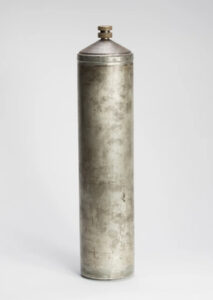 uming metal container made in 1933. Its nozzle was prone to clogging, it was expensive to manufacture and, commercially, it was not a successful. Yet today, this seemingly modest artefact it is acknowledged as one of the world’s earliest aerosol cans.
Its story began several years earlier. On 8 October 1926, Norwegian chemical engineer Erik Rotheim filed the original Norwegian patent application for an invention that would help lay the foundations for the modern aerosol dispenser. The principle was ingenious: store a product and propellant under pressure and release the contents through a valve as a spray.
While today, pressing an aerosol actuator feels completely ordinary. A century ago, achieving that simple press-and-spray experience reliably, safely and at scale was a considerable engineering challenge.
Photo: Norwegian Museum of Science and Technology
From scientific breakthrough to mass production
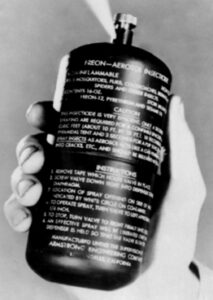
Rotheim worked with Norwegian paint manufacturer Alf R. Bjercke to develop the technology, but production costs, clogged nozzles and propellant challenges prevented the early concept from becoming commercially viable. The next breakthrough came during the Second World War, when US Department of Agriculture researchers Lyle Goodhue and William Sullivan developed a portable insecticide aerosol to help protect servicemen from insect-borne diseases in the Pacific.
Known as the “bug bomb”, around 50 million units were produced during the Second World War, demonstrating aerosol dispensing’s potential on an entirely new frontier.
Photo: USDA Agricultural Research Service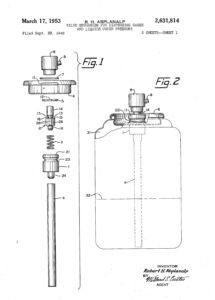
Another important development followed in 1949, when American inventor Robert Abplanalp filed a patent application for an aerosol valve designed with economical mass production in mind. This new design proved instrumental in making aerosol dispensing practical for a growing consumer industry.
The aerosol enters everyday life
During the 1950s and 1960s, aerosols began appearing across an expanding range of applications. Hairsprays, insecticides, air fresheners, deodorants and shaving foams helped bring aerosol dispensing into homes. In Europe, production grew dramatically, and the 1960s became known within the industry as the aerosol’s “golden age”.
Source: Robert H. Abplanalp, US Patent 2,631,814
But the technology was doing more than making everyday products convenient. In 1956, Riker Laboratories introduced the first pressurised metered-dose inhalers. Compact and portable, they represented a major leap forward in delivering medication directly to the lungs and helped establish a new era in respiratory treatment.
By the early 1970s, the aerosol had travelled a remarkable distance from Rotheim’s early experiments. What began as a challenging engineering concept had become a versatile dispensing technology used across consumer, technical and healthcare applications. But rapid success would soon bring a very different challenge — one that would require the aerosol industry to reinvent itself.
Next: New challenges, new solutions
Sources & further reading:
- Norwegian Museum of Science and Technology — “The world’s first spray can”
- European Aerosol Federation (FEA) — “Highlights on Aerosol History”
- Erik Rotheim — original patent record
- Robert H. Abplanalp — US Patent 2,631,814
- Stein & Thiel — “The History of Therapeutic Aerosols: A Chronological Review”